S2E12: Quit Thinking and Start Chatting
In Put Your Butt in the Chat, I wrote that my chair is a chat window now. Sit down, say what's stuck, and the reply gives me something to react to.
That works when you can say what's stuck. This one is about the harder case: you sit down and can't say what the problem is. All you have is "something's off with onboarding."
My answer sounds wrong. Start anyway.
Quit thinking is half a lie, by the way. You still think. You just do it with something in front of you instead of a blank page.
Why waiting used to be right
When a first draft of a plan or a proposal takes an hour, getting clear first makes sense. Draft the wrong thing and the hour is gone. So you think until you're clear, then draft once.
The order came from the price of a wrong draft.
With AI, a rough first attempt can take a minute. When a wrong first try costs that little, the order flips. You can start while you're still stuck, and clarity becomes the first thing the work gives you, instead of the ticket you need before you're allowed to begin.
Some people already have a version of this. A chief of staff, a junior analyst, a patient boss they can hand a half-formed mess to and say "help me work out what this is." AI makes that back-and-forth available without needing someone else's time.
The useful moment is "no, that's not it"
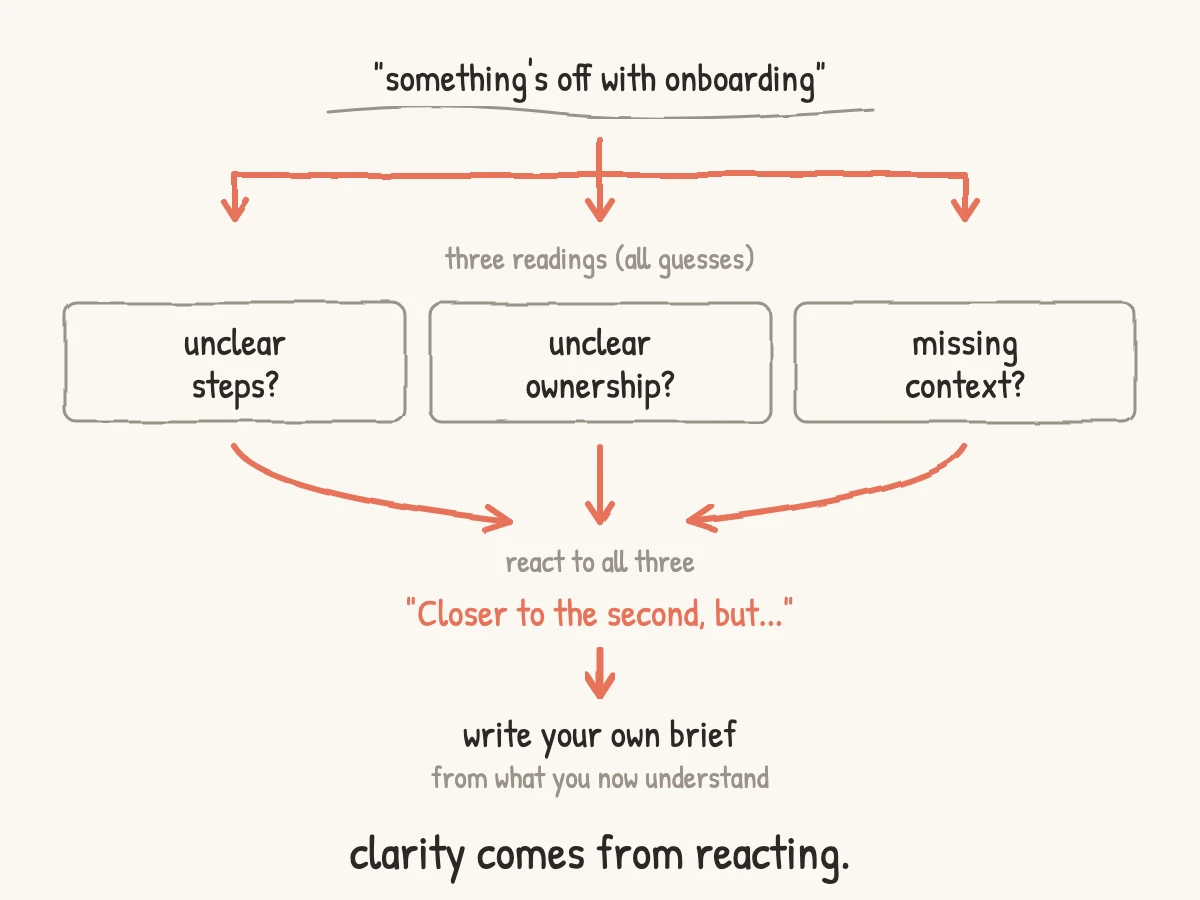
Here's what it looks like. You tell AI what's bothering you, in no order. It offers a few possible explanations for what's wrong. You react.
"No, that's not it. It's more like..."
That sentence is the whole trick. Saying what's wrong with a draft is far easier than describing the right one from scratch.
The first guess becomes your framing
Starting early has a trap: you can get stuck on the first answer. Designers shown one example can end up reusing its features, flawed ones included. Researchers call it design fixation.
One AI draft can do the same thing to you. You think you're discovering your problem. You're adopting AI's version of it.
A 2010 Stanford study suggests a way around that. Participants who made several ad designs and got feedback on them together produced better, more varied designs than those who got feedback one at a time.
In Put Your Butt in the Chat, I said the reply usually suggests five things and four are wrong. The wrong ones can still help me work out what I mean. So the rule I teach now: ask for three readings, never one.
Treat all three as guesses. React out loud: "Not the first one. Closer to the second, but it's less about the budget and more about who owns it."
Then set the guesses aside and write the brief from what you now understand. When you can say in one sentence what you're solving, you're ready to carry on.
Where it breaks
"I'm not clear on the problem" can mean four different things. I'd start with AI for the first three.
"I don't know how to prompt." You understand the situation fine. You're missing the words. Start: talk it out and let AI turn it into a brief.
"I don't know where to start." Too many pieces at once. Start: dump the pile and ask AI to name step one.
"I don't know what the real problem is." You're missing a frame. Start: three readings, react, repeat.
"I don't know what they want." The missing piece is a fact in someone else's head: your boss's real expectation, or the client's actual budget. Ask them before you draft around a guess.
That fourth one is where it goes wrong in real offices. You ask the chat what your boss wants, and it answers. Confidently. With bullet points. A fluent draft built on a guess looks finished, so it gets sent.
You have outsourced reading your boss's mind to something that has never met your boss.
When the missing piece belongs to another person, ask AI for better questions for that person. Never the answer.
The longer version, with the research and the scorecard I use to check it's working, is on the Groove blog.
What I don't know yet
The Stanford study tested ad designs. It didn't test office teams trying to understand a problem with AI. Applying that approach to a chat conversation is my own bet.
The failure I'm watching for: people take AI's first framing, call it their own, and end up with worse briefs than if they'd sat and thought. So I check whether someone can explain the problem more clearly after the conversation, not how many drafts AI produced. A draft that exists isn't progress. A problem you can state in one sentence is.
That's three posts on the same idea at three sizes now. A career in Why AI Changed the Career Game, a mental block in Put Your Butt in the Chat, one fuzzy task here. As the cost of a wrong first attempt falls, the workflow changes: instead of getting clear before you start, you start, react, and get clear through the work.
For cheap, reversible work, I'm done treating clarity as a prerequisite. If starting early consistently leads to worse decisions, I'll change my mind.